| Optical SETI Map | Conferences Map | Illustrations Map | Photo Galleries Map | Observations Map | Constructing Map |

|
Detection Of Planetary Systems9008-057
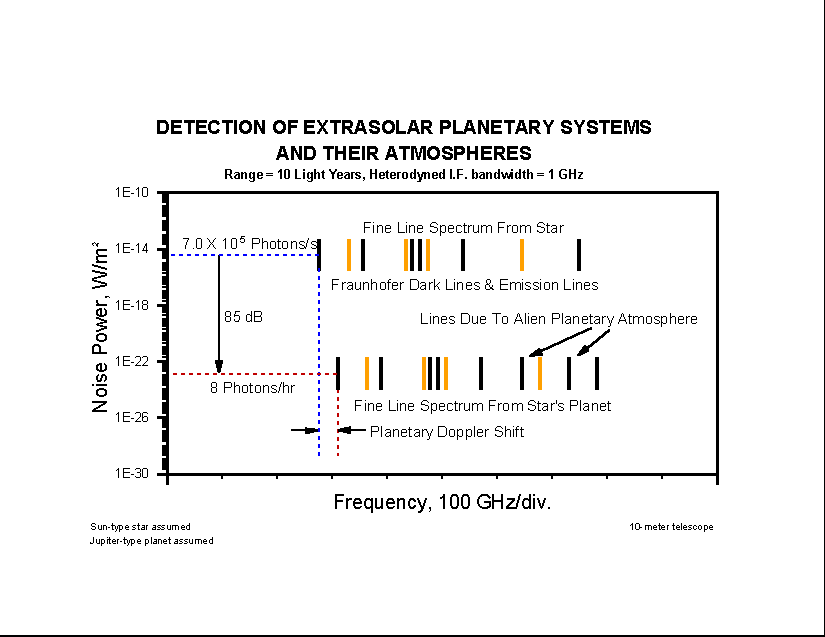
This graph illustrates an approach to improve the detectability of extrasolar planets. An optical heterodyne receiver is employed to measure the doppler-shifted spectral lines in the visible or infrared light reflected from the extrasolar planet. Since the visible photons received from such a jupiter-size extrasolar planet are some 80 dB below that of the star, it cannot be "seen" directly due to the brightness of the star overwhelming the receiver. However, by the use of the extra discrimination of placing the image of the star in a null of the receiving optics polar response, and heterodyning the spectral lines of the light from the extrasolar planet, there is a greater probability of detecting the planet.
Note: This material was included in a presentation on Optical SETI given at the NASA-Ames SETI Office on April 14, 1991. This was hosted by the late Barney Oliver. Amongst others present were John Billingham, Jill Tarter and Kent Cullers. Dr. Tarter pointed out to me that discrimination of an extrasolar planet would be easier in the infrared, due to the smaller ratio of the light emitted at that wavelength by its star.
Copyright (c), 1990, The COSETI Observatory
| ||||||