Book Reviews
I am clearly interested to see how word about the optical approach to SETI gradually
gets written up in general publications about the search for extraterrestrial
intelligence. Where appropriate, I will add brief comments to the right indicating
whether the author(s) have given a reasonable account of OSETI or have been blind-sided by
the high priests of Microwave SETI to either completely avoiding the mention of the
approach or giving it short shrift. Would-be authors of future SETI-related books
and articles are counseled that the research for their books and articles should encompass
a broad range of authorities, and not assume or be too readily persuaded that those with
established scientific reputations in the Microwave SETI field have got this right.
To obtain more expert and open-minded professional scientific and engineering opinions of
the efficacy of the optical approach to SETI, authors are recommended to speak to laser
and fiber-optics specialists. Just don't take the word of radio astronomers but go
to the real laser experts. The basic arguments for and against Optical SETI, which
are discussed all over this web site, are really quite straight
forward. To excuse a pun, "they don't take a rocket scientist to be
understood".
My comments below are not to be taken as a book review, for better or for worse, only
as factual account of the attention given to the optical approach to SETI. Where
possible, the page numbers will be given where OSETI or lasers are mentioned. If
there is a full book review on this web site an internal link will be provided. Over
the new few years I expect greater attention to be given to OSETI as the technique becomes
better known and more scientists and amateurs set up their own observatories.
However, until Project Phoenix broadens its approach to take in OSETI, which is expected
by yours truly to occur early next decade (The SETI Institute probably doesn't know this
yet!), Optical SETI will continue to be the poor step-sister of Microwave SETI.
Make no mistake, there are vested interests in trying to keep discussion of OSETI to a
minimum (the politics of SETI), for fear that funding for
Microwave SETI will be affected. Bias has many ways of manifesting itself. Very few
of us can rise to the occasion and be very objective if our source of income and
livelihood is threatened or our professional scientific activities over several decades
called into question. I am aware that some would want to disparage my technical
credibility, but you only have to search this web site for information on my professional
qualifications and photonics skills (resume) to become aware that
I surely do know something about optoelectronics - it is my
full-time job!
Stuart Kingsley
May 3, 1998
Extraterrestrial Intelligence
|
|
Author: Jean Heidmann
Cambridge University Press, 1995
ISBN 0-521-45340-2 |
Are We Alone?
|
|
Author: Paul Davies
Penguin Books, 1995 |
The UFO Phenomena
|
|
Author: Edward Ashpole
Headline Book Publishing, 1995
ISBN 0-7472-4745-5 |
Big Ear Two - Listening for Other-Worlds
|
|
Author: John Kraus
Cygnus-Quaser Books, 1995
ISBN 1-882484-12-6 |
Planet Quest - The Epic Discovery of Alien Solar Systems
|
|
Author: Ken Croswell
The Free Press, NY, 1997
ISBN 0-684-83252-6 |
After Contact - The Human Response to
Extraterrestrial Life

|
|
Author: Albert A. Harrison
Plenum Trade, NY, 1997
ISBN 0-306-45621-4 |
Telescope Control
|
|
Authors: Mark Trueblood & Russell Merle Genet
Second English Edition
Willmann-Bell, Inc., Richmond, Virginia, 1997
ISBN 0-943396-53-0 |
Handbook of Laser Wavelengths
|
|
Author: Marvin J. Weber
CRC Press, 1999
ISBN 0-8493-3508-6 |
Worlds Unnumbered - The Search For Extrasolar Planets
|
|
Author: Donald Goldsmith
University Science Books, 1997
ISBN 0-935702-97-0 |
Sharing the Universe - Perspectives on Extraterrestrial
Life
|
Book
Review by Larry Klaes |
Author: Seth Shostak
Berkeley Hills Books, 1998
ISBN 0-9653774-3-1 |

|
This is the first book, as far as I
am aware, that mentions the COSETI Observatory by giving the URL. On page 325, as a
note to page 175 in Chapter 6 it says:
"tune in to join the party". Not everyone agrees on this choice of
wavelength [the Cosmic Water Hole at 1420 MHz]. Stuart A. Kingsley, at Ohio State
University*, thinks we may find success at optical wavelengths. See http://www.coseti.org. On page 338 the URL is given
again.
*Note that I have no affiliation with OSU, just an OSU SETI Group volunteer email
address. |
Authors: David E. Fisher & Marshall Jon
Fisher
Counterpoint, 1998
ISBN 1887178872 |
Other Worlds - The Search For Life In The
Universe

|
The hard copy version of
this book consists of 13 chapters and 272 pages. Chapter 13, page 232 contains a
paragraph with a brief reference to the fact that "Maybe lasers will turn out to be
better". Charles Townes is mentioned in the same
chapter, on page 226, but only with reference to the fact that he has been involved in
SETI and was "the inventor of the laser". Actually it was its microwave
precursor - the maser - that Dr. Townes co-invented with Dr. Arthur L. Schawlow, then both
working at Bell Telephone Laboratories at Murray Hill, New Jersey. Townes shared a
Nobel Prize in physics for this work on "the maser/laser principle" in 1964 with
Nikolai Basov and Aleksander Prokhorov, four years after the first laser was
invented. Indeed, the first lasers were called "optical masers". See
Schawlow and Townes classic paper "Infrared and Optical Masers", Physical
Review, Vol. 112, pp. 1940-1949, December 15, 1958. The first laser was the ruby
laser and was invented by Dr. T. H. Maiman in 1960. In 1961,
Townes was the first to suggest the use of lasers for SETI with his colleague Dr.
Schwartz.
I had the privilege of meeting Dr. Schawlow in the early 70's when I was a postgraduate
student at University College London. I did not meet Professor Townes until the First Optical SETI Conference in 1993. His papers on
"optical heterodyne detection" were some of the first papers I read during my
Ph.D. research on coherent fiber optic data highways. Since I had spent so much of
my photonics career working with coherent laser systems, it was natural that I would apply
those techniques to Optical SETI when I first got really involved in the subject in the
summer of 1990. The second time I met Townes was immediately after the Second Optical SETI Conference in 1996, on what turned out not to
be a particularly good day for me - but that is another story. |
Author: Michael D. Lemonick
Simon & Schuster, 1998
ISBN 0-684-83294-1 |
Alien Life: The Search for Extraterrestrials
and Beyond

|
On page 170, the author says the
following about OSETI: "If we look at the various regions of the
electromagnetic spectrum we soon see that the radio region is the one best suited for
communication. Visible light is a possibility; we could, for example, communicate
with lasers. But lasers have severe restrictions compared to radio waves; they are
useless if it is overcast, and laser communication is expensive; furthermore, a laser beam
would be difficult to detect (the universe is already full of light beams). Infrared
is a region that may become increasingly important in the future, but for now the
radio/microwave region is our best bet." |
Author: Barry R. Parker
Plenum Pr, 1998
ISBN 0306457954 |
The Science of Aliens
|
|
Author: Clifford A. Pickover
Basic Books, 1998
ISBN 046507314X |
|
Looking for Earths

|
|
Author: Alan Boss
John Wiley & Sons, 1998
ISBN 0471184217 |
|
Worlds without End

|
|
Author: John S. Lewis
Perseus Books, 1998
ISBN 0738200115 |
|
|
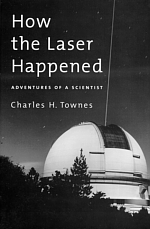
|
|
Author: Charles H. Townes
Oxford University Press, 1999
ISBN 0195122682 |
|
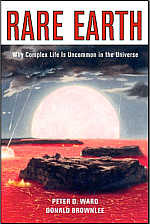
| Rare Earth: Why Complex Life is Uncommon
in the Universe
|
Book
Reviews |
Authors: Peter D. Ward and Donald Brownlee
Copernicus, 2000
ISBN 0387987010 |
|
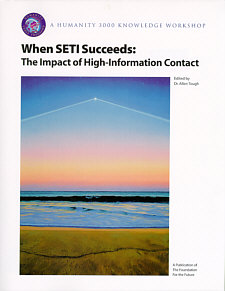
| When SETI
Succeeds: The Impact of High-Information Contact
|
Book
Reviews |
Editor: Allen Tough
The Foundation For the Future, 2000
ISBN 0-9677252-2-4 |
|
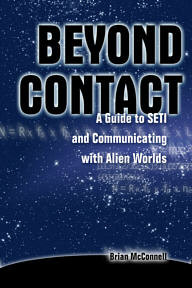
| Beyond Contact: A Guide to SETI and
Communicating with Alien Worlds
|
Book Reviews |
Author: Brian McConnell
O'Reilly & Associates, Inc., 2001
ISBN 0-596-00037-5 |
|
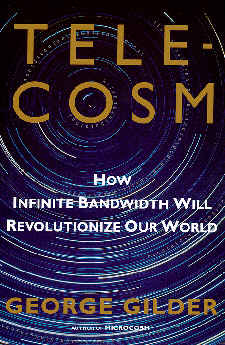
| Telecosm - How Infinite Bandwidth Will
Revolutionize Our World
|
Telescosm |
Author: George Gilder
The Free Press, 2000
ISBN 0 684 80930-3 |
|

|