| Optical SETI Map | Conferences Map | Illustrations Map | Photo Galleries Map | Observations Map | Constructing Map |

|
OSU's "Big Ear" Radio Observatory
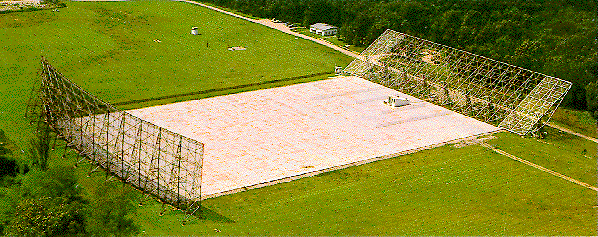
View of OSU's "Big Ear" Radio Observatory in Delaware, Ohio.History of The Ohio SETI ProgrambyDr. Robert S. DixonThe Ohio SETI Program got its first strong impetus from NASA's Project Cyclops. The goal of Cyclops, which was a paper study conducted in the 1970's, was to assess what it would take in terms of time, people, equipment, and money to mount a large search for radio signals from other civilizations. The end result was a report that was widely circulated as a NASA Special Publication, recommending a small array of radio telescopes, which would grow with time as needed.During my project Cyclops research, it became clear to me that many theoretical papers were being written about SETI, but nobody was doing any extensive actual searching. I also realized that we had a large, fully operational radio telescope available at Ohio State that was designed explicitly to search for new radio signals in the sky. (It had just completed the largest all-sky survey of natural radio signals made up to that time.) Coincidentally, this telescope was also chosen by the Russian scientist Gindilis, as the telescope most suited for SETI, because of its unique surveying ability. Although we had no money, we had a crew of able volunteers on hand. Faced with the alternative of ultimately turning off the telescope and letting it rust away, we decided that we had a responsibility to seize the opportunity that had been thrust upon us and start a real SETI program. It did not take too much arguing to convince John Kraus, Director of the OSU Radio Observatory, to allow me to use the telescope for the world's first full-time SETI program.The Ohio State Radiotelescope is larger than three football fields in size, and equivalent in sensitivity to a circular dish 175 feet in diameter. The beam of the telescope is elliptical, being 40 minutes of arc in the declination (vertical) direction, and 8 minutes of arc in the right ascension (horizontal) direction. This may be visualized by comparing it with the size of the moon, which is a 30 minutes of arc diameter circle.The telescope surveys the sky by remaining stationary and allowing the rotation of the Earth to sweep its beam in a narrow circular path through the sky once each day. After a few days of observation, the beam is moved slightly up or down, and the pattern repeated. It takes several years to thoroughly search the sky.We went on the air in 1973, using an eight channel receiver system, originally constructed for 21-cm. hydrogen line observations by Bill Brundage (who later became Chief Engineer of the 300 foot telescope at Green Bank, and still later was responsible for preparing the Very Large Array to receive Voyager spacecraft signals from Neptune). The bandwidths of the channels ranged form 10 to 50 kHz, depending on their distance from the center frequency. The output of the eight channels was plotted as wiggly lines on pen recorders. The charts were laboriously searched for unusual signals by graduate student Dennis Cole (now a contractor to JPL), and used as the subject for his master's thesis in Electrical Engineering. This may have been the first graduate degree ever awarded in SETI.The search strategy chosen then was to search in the vicinity of the 21 cm hydrogen line, doppler correlated to the Galactic Standard of Rest. Due to the random motions of the stars and the rotation of our galaxy, signals transmitted at the hydrogen line frequency (1420.4056 MHz) would be received at somewhat different frequencies because of the doppler shift. To avoid this frequency ambiguity, we made the deliberate assumption that any civilization transmitting at the hydrogen line would offset their transmission frequency in just the right way to remove all their motions with respect to the center of the galaxy, which is the only unique reference point shared by all the galactic inhabitants. Then it was up to us to offset our receiver frequency to compensate for Earth's motions, to arrive at this unique "galactic" frequency. Because of man's uncertainty about our galactic rotation velocity (we measure it by observing the motions of the stars and gas in our neighborhood), we still had to search a total bandwidth of several hundred kHz. A lot of chart paper was generated during the two years this effort continued, but no recognized signals of intelligent origin were found.The old IBM computer was built like a battleship and ran without fail for many years. Its operating system could run huge programs in a tiny memory very efficiently. It was fast, even by today's standards.Over the years, a few cold hydrogen clouds were found, and huge piles of computer printouts accumulated. There was no magnetic tape drive or equivalent device available, so there was no way to record all the data permanently in computer-readable form. Only the small fraction of data represented by the "interesting" signals was preserved in computer- readable form. Along the way, a small NASA grant was received, which continues today.Two types of unexplained signals were detected during this search. The first kind is quite rare, with the best example being the "Wow!" signal found in 1977. This name was unintentionally applied from Jerry Ehman's comments in the margin of the computer printout when he noticed the signal.What was the "Wow!" signal? Probably we will never know. Conceivably it could have been a secret military satellite in solar orbit, transmitting on an illegal frequency (military transmitters often ignore civilian agreements). Its characteristics rule out any terrestrial transmitter, or any near-earth satellite or reflection from space debris, or equipment malfunction. Perhaps it was a transmission from some other civilization. If so, it seems that they were not trying very hard to attract our attention, since the signal disappeared before we could really find out what it was.The other kind of unexplained signals we receive are much more numerous. These are narrowband pulses (lasting less than 10 seconds) which go "bump!" in the night. There have been thousands of such signals received, apparently from all over the sky, and never from exactly the same direction more than once.Clearly these signals are not from any single source (intelligent or otherwise), but they are very interesting in their own right, and could be some form of previously unknown astrophysical phenomenon. Of course pulsed signals like these could easily be caused by terrestrial radio interference or equipment malfunction. But if that were their source, then they should appear randomly scattered across the sky. The interesting thing is that they do not. They exhibit a zone of avoidance along the galactic place, and areas of concentration above and below the galactic center, along the galactic north and south polar axes.It is possible that the zones of avoidance and concentration are caused in some complex unknown way by an interaction between the galactic continuum radiation and the automatic gain and baseline correction algorithms in the computer. We simply do not know. A resurvey of a portion of the same area shows roughly the same effect, so the phenomenon appears to be repeatable. We plan to resurvey this area again with all new equipment in the future.At one point, there was danger that the telescope would be destroyed. The land under and around the telescope was sold without our knowledge to a developer who wanted to enlarge the neighboring golf course. The developer wanted the telescope torn down and completely removed. This created a furor that was widely reported in the world press. After great struggle and with help from many people, the telescope was saved and a long-term lease was signed for the land.For several years, we published the first and only SETI magazine, called Cosmic Search. Its editorial board included all the world-wide luminaries of SETI. The magazine was a technical and popular success, receiving great praise on all fronts. But it was a financial failure and finally folded after the thirteenth issue.In the mid 1980's, a new and more powerful computer was donated by the Digital Equipment Corporation, and we began what we knew would be years of effort to place it into operation in the next generation of the Ohio SETI program. Unfortunately, while this development was proceeding, the old IBM computer came to a premature death at the hands of a mouse. The mouse built a nest at the air intake to the disk drive, and cut off the air supply. This caused the disk drive to destroy itself. IBM said the computer was so old that it would cost a lot of money to fix it, and they would not guarantee it to work normally even after it was fixed. So regretfully we abandoned the IBM computer to devote all efforts toward getting the new DEC computer operational. During the years of 8 channel and 50 channel observations, we accumulated more on the air SETI observing time than all earlier or contemporary SETI programs combined.The new system (soon to be in full operation) has many improvements over the earlier one. No assumption as to exact signal frequency is made, as the entire water hole (1.4-1.7 GHz) is searched continuously in 3,000 channels. When a signal is found the search is temporarily suspended, so that the signal may be examined immediately in great detail, and studied for an hour or so. This avoids the problem encountered by other SETI programs where interesting signals are found after-the-fact as part of a systematic search, but are no longer there when re-observations are attempted. An on-line catalog of known Radio Frequency Interference sources is maintained, and used by the computer to ignore them.A new type of radio telescope is being designed, and a small prototype has been successfully tested. This telescope is called a Radio Camera, since it forms an image of the entire sky at once. This avoids the possibility that a signal might arrive from an unexpected direction, but be missed by radio telescopes that are looking in "likely" directions. Jim Bolinger wrote his master's thesis describing the prototype, and plans are now being made to build a much larger one. We have named this the Argus telescope, after the mythological being that had 100 eyes and could see in all directions at once.The Flag of Earth flies at the OSU Radio Observatory, as well as many other SETI locations around the world. It symbolizes the fact that SETI is carried out on behalf of Humankind as a whole; and the individual people, organizations, or nations involved are not relevant.1990Stuart Kingsley is a volunteer with the OSU SETI Group
Appeal by Arthur C. Clarke to save OSU's Radio Observatory Web: The Cygnus-Quasar Books (Dr. John Kraus)
| ||||||