| Optical SETI Map | Conferences Map | Illustrations Map | Photo Galleries Map | Observations Map | Constructing Map |

|
|
The Columbus Astronomical Society
The Search for Extraterrestrial Intelligence
in the
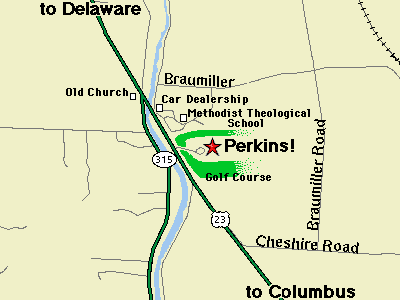
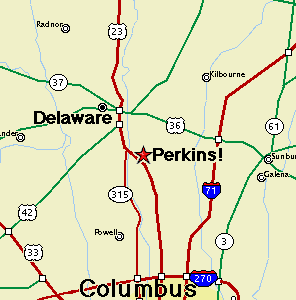
Venue: Perkins Observatory St.Rt. 23 Delaware, Ohio 43015.
The CAS web site is at http://www.the-CAS.org
Over the past decade, Dr. Stuart Kingsley, a distinguished photonics engineer living in Columbus, Ohio, has revisited the optical search for extraterrestrial intelligence. Stuart moved to Columbus, Ohio from London, England, in 1981. Almost single-handedly, he has caused mainstream SETI scientists to reconsider their over-emphasis of the microwave approach to SETI. Stuart has been aided by The Columbus Optical SETI's Web site www.coseti.org and two conferences on Optical SETI (OSETI). A third international conference scheduled for 2001. Dr. Kingsley was vindicated in the summer of 1998, when the SETI Institute and The Planetary Society decided to set up their own Optical SETI research activities. Now that the opposition to Optical SETI, which has lasted for over a quarter-of-a-century, has largely abated and mainstream OSETI activities are underway, we can expect worldwide Optical SETI research activities to substantially increase. Indeed, Stuart Kingsley confidently expects that by the year 2005, most SETI activities on this planet will be optical in nature. Dr. Kingsley has also called for the instrumentation of space-based telescopes for optical SETI research, for it is possible that if there are attention-getting laser beacon signals being directed at the Earth by ETIs, they are not at a wavelength at which the atmosphere is transparent. In his Ohio University talk, Dr. Kingsley will give a sense of the history of Optical SETI over the past 40 years, and how you can set up your own Optical SETI observatory and participate in this exciting research. Stuart will also make some personal observations about how new scientific ideas sometimes do not get the attention they deserve, despite their "obvious" merit.
Abstract This talk will describe the rationale behind the optical search for extraterrestrial intelligence, the design and construction of the first Visible Optical SETI Observatory in North America and describe new Optical SETI (OSETI) programs started by other research groups. This talk deals primarily with the superiority of free-space interstellar optical (laser) beamed communications over its microwave counterpart. The advantage that free-space laser communications has over microwaves is demonstrated with respect to both future interstellar communications with our deep space probes and for SETI-type interstellar communications. The Columbus Optical SETI Observatory, otherwise knows as
"The COSETI Observatory", is the world's first observatory dedicated
to Optical SETI. The modern definition of "optical" is used here
to cover the entire electromagnetic spectrum, from above the millimeter wave
band to the ultraviolet. The optical approach to searching for ETI
technologies touches on a subject which for various reasons has only recently
begun to be accepted by the majority of the SETI community. The presenter
has been investigating this subject since 1990. Indeed, 2001 will mark the
40th anniversary of the paper by Schwartz and Townes
that first suggested the laser approach to SETI. The fact that it has
taken nearly 40 years for the optical approach to become accepted as a viable
SETI technique is an historical accident caused in main, by the conclusions of
the famous Cyclops Report; a 1973 publication that is
often revered to as the "SETI Bible".
Dr. Stuart A. Kingsley Biography Stuart A. Kingsley was born in London, England on May 15,
1948. He received a B.Sc. Honors and Ph.D. in Electronic and Electrical
Engineering from The City University, London, England, and University College
London, England, in 1972 and 1984, respectively. He arrived in the states
in 1981, and went to work for Battelle Columbus Division as a Principal Research
Scientist, becoming a Senior Research Scientist in 1985. He left Battelle
in 1987 and established his own photonics consultancy business Fiberdyne
Optoelectronics. Since 1992 he has been the VP for Engineering at SRICO,
Inc. He is the Director of The Columbus Optical SETI Observatory.
NASA's Cyclops Report, 1973. Obtainable from the SETI League and the SETI Institute. Stuart A. Kingsley (Editor), "The Search for Extraterrestrial Intelligence (SETI) in the Optical Spectrum", SPIE Proceedings Vol. 1867, OE LASE '93, Los Angeles, California, January 21-22, 1993. Paul Davies, "Are We Alone? - Implications of the Discovery
of Extraterrestrial Life", Penguin Books, 1995. See page 94 for a
brief mention of work on Optical SETI, and also the review
of this book by Arthur C. Clarke in the March 17 issue of The Times Higher
Educational Supplement (page 24). Stuart A. Kingsley & Guillermo Lemarchand (Editors), "The Search for Extraterrestrial Intelligence (SETI) in the Optical Spectrum", SPIE Proceedings Vol. 2704, Photonics West '96, San Jose, California, January 31 - February 1, 1996.
Sky & Telescope, December 1998, pp. 44-48.
First Posted: January 25, 2000
| ||||||